
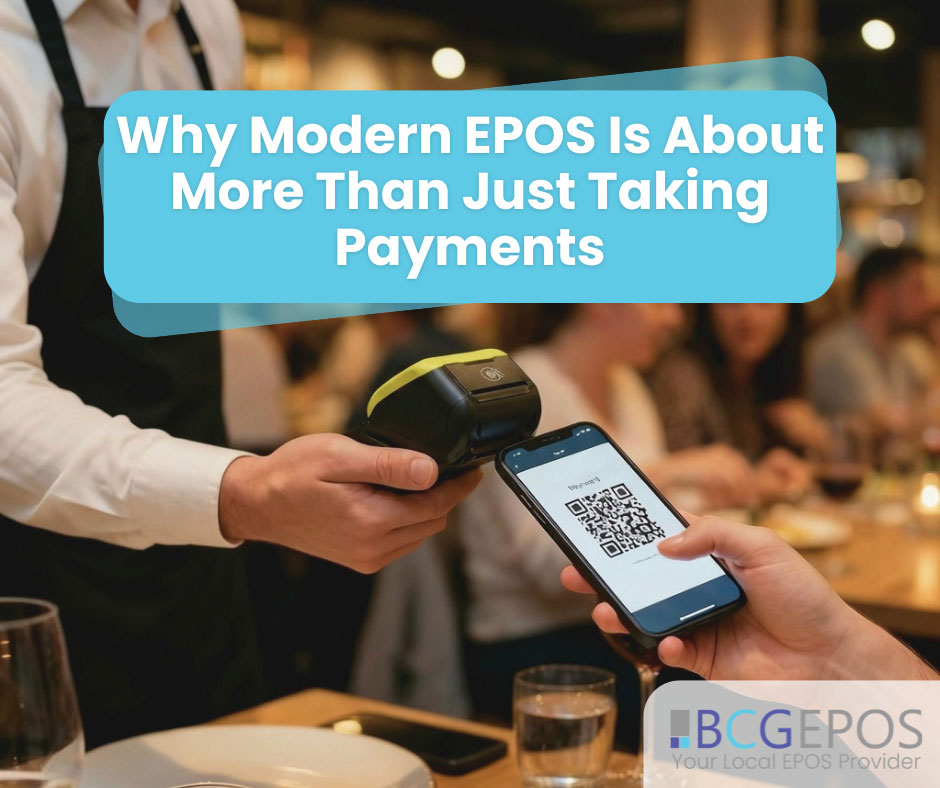
For many hospitality businesses, EPOS has traditionally been viewed as a necessary tool. Something that processes transactions, prints receipts and keeps service moving. But in today’s environment, that view is outdated.
Modern EPOS is no longer just about taking payments. It sits at the centre of your entire operation. It connects front of house, kitchen workflow, reporting, ordering channels and management visibility into one system.
If your EPOS only takes orders, you are missing the point.
The Shift from Standalone POS to Integrated EPOS Systems
The biggest change in recent years has been the move away from standalone POS systems towards fully integrated EPOS ecosystems.
Older systems were often built to perform a single function. They processed transactions, but operated in isolation. Kitchen communication, reporting and ordering channels were handled separately or manually.
Modern EPOS systems are designed differently. They connect multiple parts of the business into one platform. Orders flow directly from POS terminals, handheld devices or kiosks into kitchen display systems. Data is captured in real time and made available through centralised reporting tools.
This level of integration reduces friction across the operation. It removes duplication, improves accuracy and allows teams to work more efficiently during busy service periods.
For hospitality businesses, this is no longer a luxury. It is becoming the standard.
Connected Hospitality Technology Across Front and Back of House
A modern hospitality EPOS system must support the full service journey, not just the transaction at the end.
Front of house and back of house need to operate in sync. Orders taken at the table using handheld POS devices should appear instantly on kitchen screens. Updates, modifiers and special requests should be communicated clearly without relying on manual input.
At the same time, alternative ordering channels such as QR ordering and self-service kiosks should feed into the same system. Without this level of connection, operations become fragmented and harder to manage.
Connected hospitality technology ensures that every part of the service process is aligned. Staff spend less time navigating systems and more time focusing on customers.
For operators, this creates a more controlled and predictable service environment, even during peak trading.
Real Time Data, Reporting and Operational Visibility
One of the most valuable aspects of modern EPOS is the visibility it provides.
With cloud based EPOS software, operators can access real time sales data, monitor performance and make informed decisions without delay. This is particularly important in hospitality, where margins are tight and service conditions change quickly.
Modern reporting tools allow businesses to:
Track live sales across multiple locations
Identify best performing products and time periods
Monitor staff performance and service efficiency
Adjust pricing and menus based on real data
For multi site hospitality businesses, centralised reporting becomes even more powerful. Instead of relying on end of day summaries, operators can view performance across all venues in real time.
This level of insight is not possible with outdated or disconnected systems.
Why a Hospitality EPOS System Needs to Be Built for Integration
Choosing a hospitality EPOS system is no longer just about features. It is about how well those features connect.
A system that includes POS terminals, handheld ordering, kitchen display systems and kiosks is only effective if those elements are fully integrated. If they operate separately, they create more complexity rather than solving problems.
Modern EPOS infrastructure is built with integration at its core. Each component works as part of a wider ecosystem, ensuring consistency across ordering, communication and reporting.
This approach reduces errors, improves service speed and provides a clearer view of how the business is performing.
For hospitality operators, the focus should not be on individual tools, but on how those tools work together.
Introducing the ACE EPOS Ecosystem
At BCG EPOS, this is exactly the approach we have taken with the ACE ecosystem.
Rather than supplying standalone products, ACE brings together POS, handheld ordering, kitchen display systems, kiosks and management reporting into one connected platform.
Each element is designed to work seamlessly with the others. Orders flow in real time. Data is centralised. Reporting is consistent across the entire operation.
For hospitality businesses, this means fewer workarounds, fewer points of failure and a more streamlined service process.
It also means the system can scale as the business grows. Whether you are operating a single site or multiple venues, the infrastructure remains consistent and adaptable.
Modern EPOS as a Foundation for Growth
As hospitality continues to evolve, the role of EPOS will only become more important.
Customers expect faster service, greater convenience and a seamless experience across different ordering channels. At the same time, operators need better visibility, stronger control and systems that can support growth.
Modern EPOS provides that foundation.
It is not just about taking payments. It is about connecting your entire operation, improving efficiency and giving you the tools to make better decisions.
If your current system is limited to processing transactions, it may be time to rethink what you expect from your EPOS.
To learn more about how a modern, integrated EPOS system can support your business, visit:
Or speak to our team on 01803 313 222.