
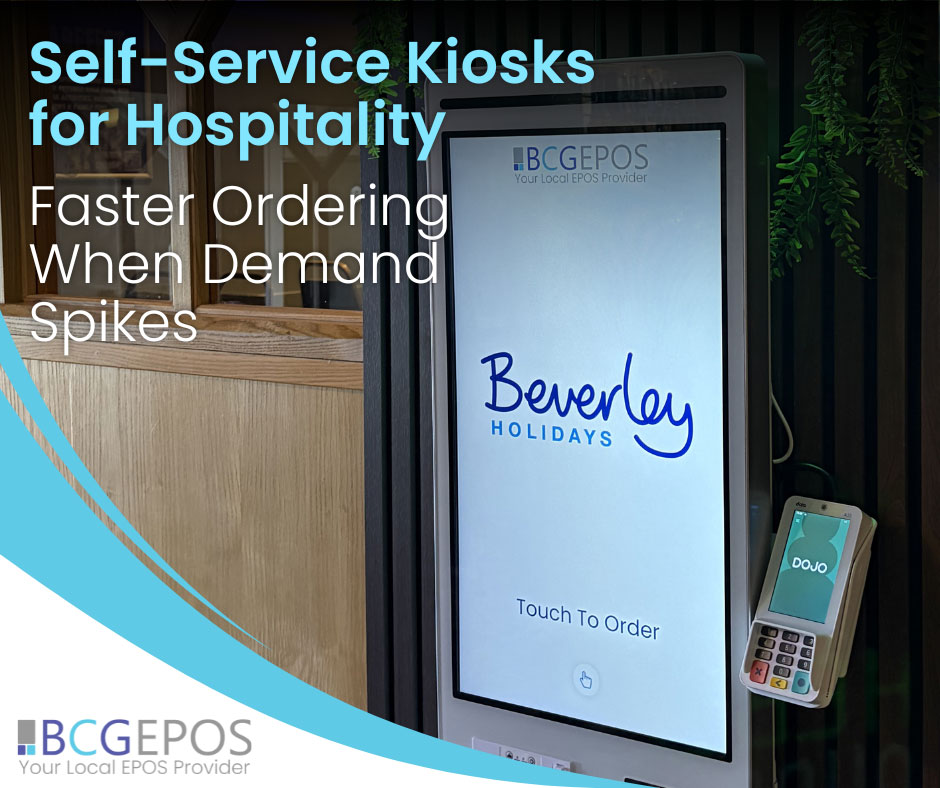
Busy periods can put serious pressure on hospitality businesses. When queues start building, staff are stretched and customers are waiting longer, every part of the ordering process matters.
For restaurants, quick service venues, takeaways, food halls, leisure sites and high footfall hospitality environments, self-service kiosks can help manage demand more effectively. They give customers another way to place orders, reduce pressure at the counter and help keep service moving when volumes increase.
However, self-service kiosks for hospitality should not be viewed as standalone ordering screens. The real value comes when kiosks are connected properly into the wider EPOS system, kitchen workflow and reporting tools. When that happens, businesses can increase ordering capacity without losing control over service, accuracy or visibility.
Managing Busy Summer Periods with Hospitality Self-Service Kiosks
Summer trading often brings higher footfall, longer opening hours and more intense peaks in demand. Whether you are managing a busy restaurant, attraction, takeaway, event venue or seasonal hospitality site, customer volume can change quickly.
During these periods, relying only on traditional counter ordering can create bottlenecks. Staff may be taking orders, answering questions, processing payments and managing queues all at once. As pressure increases, service speed can drop and mistakes become more likely.
Hospitality self-service kiosks give operators an additional ordering channel. Customers can browse the menu, customise their order and pay without waiting for a member of staff to become available at the till.
This does not remove the need for staff. Instead, it helps businesses use their team more effectively. Staff can focus on preparing orders, supporting customers, managing collection points and keeping the venue running smoothly during peak periods.
For businesses preparing for summer demand, kiosk ordering can be a practical way to increase capacity without creating unnecessary pressure behind the counter.
Reducing Queues and Wait Times with Kiosk Ordering Systems
Long queues can quickly affect the customer experience. Even when the food or drink is good, waiting too long to place an order can create frustration before the service has properly begun.
Kiosk ordering systems help reduce this pressure by allowing multiple customers to place orders at the same time. Instead of every transaction going through one or two fixed tills, kiosks create extra ordering points across the venue.
This is particularly useful in high volume hospitality environments where speed and consistency matter. Quick service restaurants, takeaways, food courts, entertainment venues and visitor attractions can all benefit from faster order entry.
Customers also gain more control over the ordering process. They can take their time browsing the menu, reviewing options and checking their order before confirming it. This can make the experience feel calmer, even during busy trading periods.
For operators, shorter queues can support better flow through the venue and help prevent staff from becoming overwhelmed at peak times.
Improving Order Accuracy Through Self-Service Technology
Order accuracy is a major benefit of self-service kiosks in hospitality.
When customers enter their own orders, there is less chance of miscommunication between the customer and staff member. Menu items, modifiers, extras and special requests can be displayed clearly on screen, helping customers build their order accurately before payment.
This can reduce common errors caused by rushed conversations at the counter, background noise or unclear verbal communication.
For kitchens and preparation teams, clearer order information helps reduce mistakes and improve consistency. Orders arrive with the selected options already attached, making it easier for staff to prepare exactly what the customer requested.
Improved order accuracy does more than prevent complaints. It also reduces waste, saves time and helps teams avoid remaking incorrect items during already busy periods.
Connecting Kiosk Orders into Wider EPOS and Kitchen Systems
The success of self-service kiosks depends heavily on integration.
A kiosk that operates separately from the main EPOS system can create more problems than it solves. Orders may need to be re-entered manually, kitchen teams may have to manage separate order streams and reporting may become fragmented.
For self-service kiosks to work properly, orders should flow directly into the wider hospitality POS system. From there, they should be routed to the correct kitchen display system or preparation area in real time.
This ensures kiosk orders sit alongside orders from tills, handheld devices, QR ordering or other service points. Staff can manage everything through one connected workflow rather than juggling disconnected systems.
Integrated EPOS and kitchen systems help maintain control. Orders are clearer, reporting is more accurate and the kitchen can prioritise work more effectively during busy trading.
This is where a connected approach makes all the difference. Kiosks should strengthen the operation, not create another separate process for staff to manage.
Reporting Benefits from Integrated Self-Service Kiosks
Self-service kiosks can also provide valuable reporting data when they are connected to the wider EPOS system.
Every kiosk transaction can feed into central reporting, giving operators better visibility over sales, product performance and customer ordering behaviour. This information can help businesses understand which items are performing well, when demand is highest and how customers are using different ordering channels.
For multi-site operators, this data becomes even more useful. Performance can be reviewed across different venues, helping managers compare trading patterns and identify opportunities for improvement.
Without integration, kiosk data can sit separately from other sales information. That makes it harder to get a full picture of how the business is performing.
A properly connected system gives hospitality operators clearer insight and better control.
Where Self-Service Works Best in Hospitality Environments
Self-service kiosks are not right for every hospitality business, but they are highly effective in the right environments.
They work particularly well where menus are structured, customers are comfortable ordering independently and service speed is a priority. This includes quick service restaurants, takeaways, cafés, food halls, leisure venues, visitor attractions, event spaces and busy seasonal hospitality sites.
Kiosks can also be useful in venues that experience sudden spikes in demand. For example, lunch rushes, pre-event ordering, school holiday periods, summer trading and weekend peaks can all place extra pressure on counter service.
In more traditional table service restaurants, kiosks may play a more limited role. However, they can still be useful for specific areas, such as grab and go counters, takeaway sections or high volume ordering points.
The key is to match the technology to the service model. Self-service works best when it solves a real operational challenge rather than being added for the sake of it.
Self-Service Kiosks for Hospitality That Support Staff and Customers
There is sometimes a misconception that kiosks are only about replacing staff. In practice, they are often more valuable when used to support staff.
By reducing pressure at the order point, kiosks allow teams to focus on areas where human service matters most. Staff can help customers who need assistance, keep orders moving, manage collection areas and maintain the overall experience.
For customers, kiosks can make ordering quicker and more convenient. For staff, they can reduce repetitive pressure during peak times. For operators, they provide another way to manage volume while maintaining visibility and control.
This balance is what makes self-service kiosks a strong option for many hospitality businesses.
Choosing the Right Self-Service Kiosk Setup for Your Venue
If you are considering self-service kiosks for your hospitality business, the most important question is not simply which hardware to choose. It is how the kiosk will connect to the rest of your operation.
You should consider whether kiosk orders will feed into your main EPOS system, whether they will connect to kitchen display screens, how reporting will be managed and how staff will support customers using the system.
At BCG EPOS, we work with hospitality businesses to provide self-service solutions that are designed to fit into wider operational workflows. The focus is on creating connected systems that support speed, accuracy and control, especially when demand increases.
If your venue is preparing for busier trading periods and you want to explore how self-service could support your team, BCG EPOS can help you assess the right approach.
To learn more about self-service kiosks for hospitality, visit:
https://bcgepos.com/selfservice/
Or speak to the BCG EPOS team on 01803 313 222.