
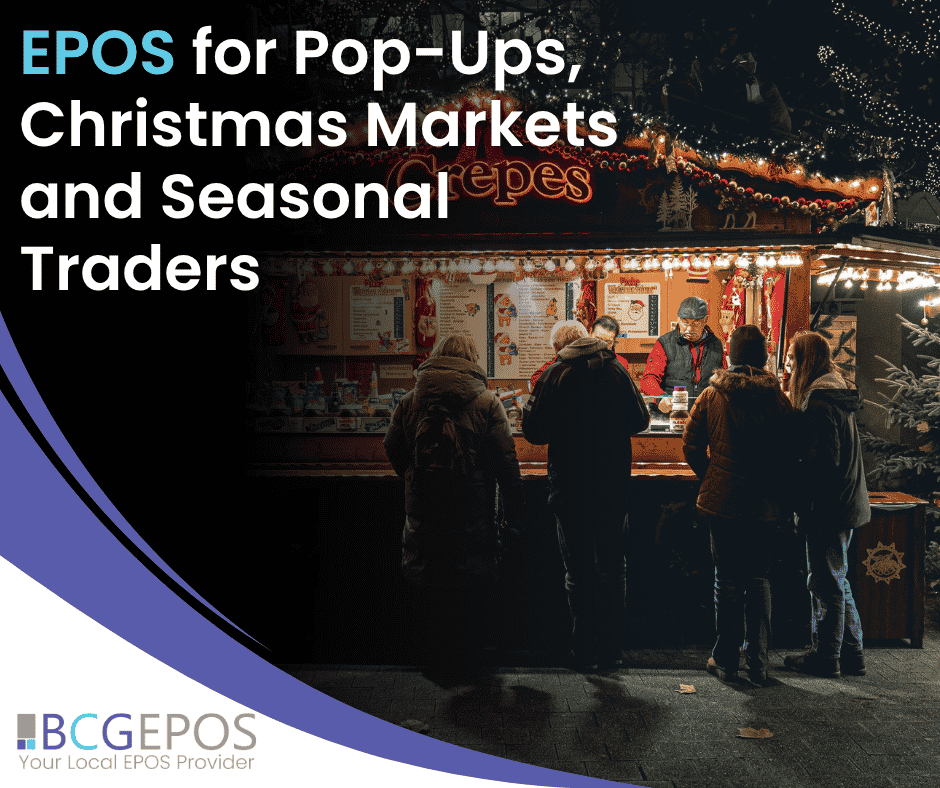
Seasonal trading can move quickly. A business may have only a few days to set up, a short window in which to make the most of customer demand and very little tolerance for technology that slows service down.
That is why EPOS for Pop-Ups needs to be simple, reliable and built around the realities of temporary trading.
Christmas markets, food stalls, temporary bars, winter events and seasonal attractions do not necessarily need the same EPOS setup as a permanent restaurant or retail store. They do, however, need dependable ways to take orders, process card payments and keep queues moving when footfall increases.
For seasonal traders, the goal should not be to install the biggest system possible. It should be to create a practical setup that can be deployed quickly, used confidently by the team and relied upon throughout the trading period.
EPOS for Christmas Markets Needs to Be Quick and Dependable
EPOS for Christmas markets has a very specific job to do.
Trading windows are short, customer volumes can change quickly and many transactions need to be completed in a matter of seconds. Whether a stall is selling food, drinks, gifts or seasonal products, customers are unlikely to want to wait while staff struggle with complicated menus or an unreliable payment process.
A good Christmas market POS system should therefore make the basics extremely straightforward.
Products need to be easy to find. Orders need to be entered quickly. Card and contactless payments need to be simple. Staff should be able to understand the system without lengthy training, particularly where temporary or seasonal team members are involved.
The physical setup matters too. Space inside a market stall or chalet is often limited, so a compact or portable EPOS system can make far more sense than a large counter installation.
The right technology should fit into the trading environment rather than becoming another obstacle for staff to work around.
EPOS for Seasonal Traders During Short-Term Trading Periods
EPOS for seasonal traders needs to deliver value even when the business is only trading for part of the year.
An ice cream business may see most of its demand during spring and summer. A Christmas trader may operate intensively for six weeks and then stop until the following year. Event businesses might move between festivals, fairs and temporary venues throughout the calendar.
Those businesses still need professional systems, but their requirements are different from a permanent venue trading every day.
A seasonal EPOS setup should be easy to deploy and straightforward to manage. It should help traders record sales accurately, take payments efficiently and understand how the trading period is performing without adding unnecessary complexity.
That is particularly useful when a short seasonal window represents an important proportion of annual revenue. When every busy weekend matters, reliable ordering and payment technology becomes part of making the most of that opportunity.
Portable EPOS Systems for Food Stalls and Pop-Up Businesses
Food stalls and pop-up hospitality businesses often operate with very little spare space and a constant focus on speed.
A customer approaches the counter, places an order, pays and expects the process to move quickly. During a busy market or event, even small delays can result in longer queues and additional pressure on staff.
A portable event EPOS system can help simplify that process.
For some businesses, a compact touchscreen setup may be appropriate. For others, an all-in-one or handheld device capable of supporting both ordering and payment may provide greater flexibility.
ACE POS is designed to support flexible hospitality environments and can operate across supported touchscreen tills, tablets and compatible payment devices. That gives businesses options when a traditional fixed counter setup is not practical.
This flexibility is particularly useful for food stalls, mobile traders, pop-up cafés and temporary hospitality concepts where the physical trading environment may change from one event to the next.
Card Payment Machines for Pop-Ups and Temporary Events
Card and contactless payments are central to modern event trading.
Customers attending Christmas markets, festivals and temporary events increasingly expect to be able to pay quickly without cash. For the trader, that means the payment terminal cannot be an afterthought.
A reliable card payment machine needs to fit into the wider trading process.
Where the payment terminal and EPOS system work together, staff can avoid repeatedly entering transaction values into separate devices. That can make each transaction quicker and reduce the risk of the wrong amount being entered when queues are building.
BCG EPOS supports Teya EPOS integration as part of its wider payment offering, providing businesses with another route to create a simpler order and payment process.
For temporary traders processing hundreds or thousands of transactions over a short period, saving a small amount of time on each transaction can have a meaningful impact across the whole event.
Winter Wonderland Plymouth: EPOS for a Six-Week Seasonal Event
A useful example of this kind of temporary setup is Winter Wonderland in Plymouth.
For a six-week trading period, the event used ACE POS alongside Teya card machines to support its seasonal operation.
It is a good illustration of why temporary does not mean unimportant.
A six-week event may not need the same long-term setup as a year-round hospitality venue, but during those six weeks the system still has to perform. Orders and payments need to work reliably when the venue is busy, and staff need technology that they can use confidently throughout the trading period.
Seasonal events can experience concentrated demand, with evenings, weekends and the period immediately before Christmas creating significant peaks in footfall. A system that feels adequate during a quiet hour can be tested very differently when large numbers of customers arrive together.
That is why choosing event EPOS around real peak trading conditions matters.
EPOS for Temporary Bars and High-Volume Events
Temporary bars have their own set of pressures.
Transactions are often simple, but they need to happen quickly. Customers may be ordering several drinks at once, staff may be working in a temporary environment and busy periods can create queues almost instantly.
EPOS for events should help temporary bars keep that transaction process as clear and efficient as possible.
Simple product layouts can make drinks easier to find. Integrated or connected payments can reduce unnecessary steps. Reliable hardware gives staff greater confidence when the pressure increases.
For larger events, operators may also need several devices working across different service points. The setup should therefore be considered around expected volume, staffing and the layout of the event rather than simply choosing a till and hoping it will be enough.
A well planned temporary bar setup can make service considerably easier for staff and create a better experience for customers standing on the other side of the counter.
Event EPOS Hardware Should Match the Trading Environment
Hardware for a permanent venue can be chosen around a fixed counter, reliable power and a consistent layout. Seasonal traders do not always have those luxuries.
Markets, festivals and outdoor events may involve compact pitches, temporary structures or service points that change depending on the event.
That makes choosing appropriate EPOS hardware especially important.
The right solution might include a touchscreen terminal, portable device, receipt printer or payment terminal depending on how the business operates. The priority should always be to avoid adding equipment that the trader does not actually need.
For a simple seasonal stall, less can be more. A streamlined setup that allows staff to enter orders and take payments confidently may be far more useful than a complex system loaded with features that will never be used.
The system should be designed around the environment, available space, transaction volume and way customers are served.
Pop-Up EPOS Can Still Give Traders Useful Sales Visibility
Temporary trading does not mean sales information becomes less important.
In fact, seasonal businesses often have a particularly strong reason to understand performance because there may be limited time to make changes.
Knowing which products are selling well, when the busiest trading periods occur and where revenue is coming from can help operators make better decisions during the event itself.
A Christmas market trader might discover that certain products perform much better during evening trading. A temporary bar may identify its busiest service periods. A food stall can see which menu items account for the greatest volume.
That information can help with stock preparation, staffing and product decisions throughout the remaining trading period.
A good EPOS system therefore gives seasonal traders more than a way to take money. It also creates useful information about what is actually happening within the business.
Setting Up EPOS for Pop-Ups Before the Event Starts
One of the biggest mistakes a seasonal trader can make is leaving the EPOS setup until the last minute.
Products, pricing and menus should be configured before trading starts. Card payment devices should be prepared, staff should understand how to use the system and the physical hardware setup should make sense within the available space.
For Christmas markets in particular, preparation needs to happen before the busiest part of the season arrives.
At BCG EPOS, the focus is on configuring systems around the way the business will actually trade. That could mean creating a streamlined product layout, recommending appropriate hardware or helping a trader decide whether a compact ACE POS and payment setup is more appropriate than a traditional fixed installation.
Planning the system properly means staff can concentrate on customers when the doors, shutters or market stalls finally open.
Choosing EPOS for Pop-Ups, Christmas Markets and Seasonal Traders
Temporary businesses still need dependable technology.
Whether you are preparing for a Christmas market, running a seasonal food stall, opening a temporary bar or taking your business to events around the South West, your EPOS setup needs to make ordering and payments easier rather than adding more work.
The right solution should be quick to use, appropriate for the available space and reliable when customer numbers increase. It should also reflect the length and nature of the trading period rather than forcing a seasonal operator into an unnecessarily complicated setup.
BCG EPOS works with businesses across Devon and the wider South West to build practical EPOS and payment setups around real trading environments, including pop-ups, events and seasonal operations.
To find out more about EPOS for Pop-Ups and events, visit BCG EPOS or speak to the team on 01803 313 222.