
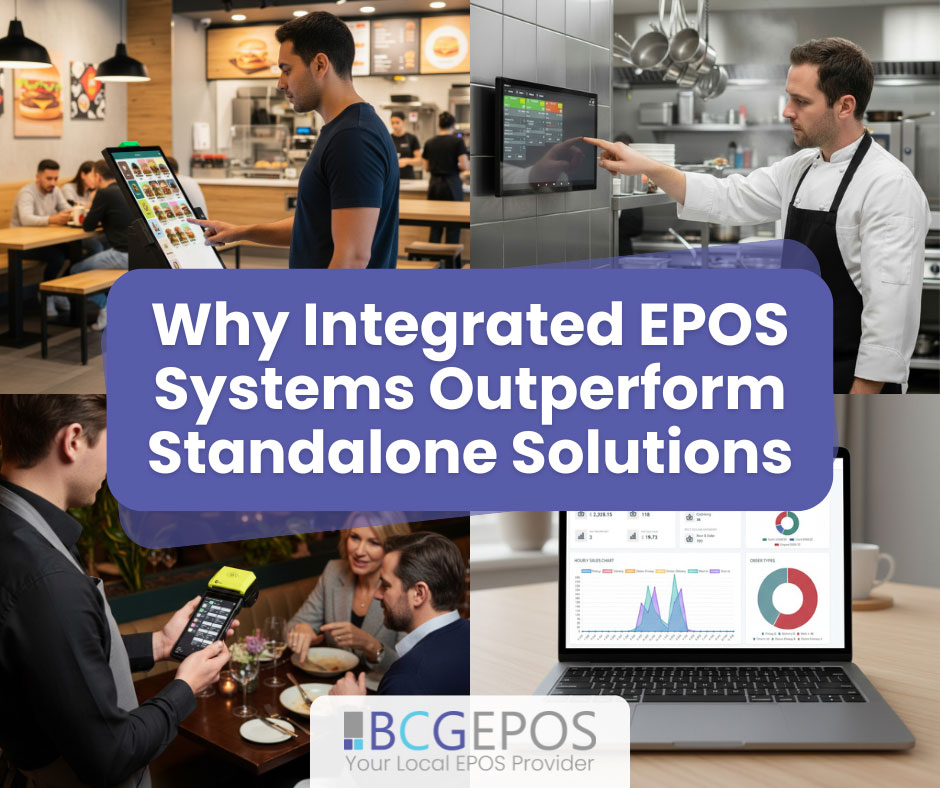
For many hospitality businesses, EPOS has evolved gradually. A POS system here, a kitchen screen added later, perhaps handheld devices or online ordering introduced as the business grows.
Over time, this can lead to a fragmented setup where different systems operate independently. While each tool may work on its own, the overall operation becomes harder to manage.
This is where the difference between standalone and integrated EPOS systems becomes clear. Modern hospitality businesses are moving towards fully connected platforms that bring every part of the operation together.
If your systems are not integrated, you are likely working harder than you need to.
The Problems with Disconnected Hospitality EPOS Systems
Disconnected systems are one of the most common challenges we see when speaking to hospitality operators.
A standalone POS system may process transactions effectively, but if it does not connect with kitchen display systems, handheld devices or reporting tools, gaps begin to appear.
These gaps often lead to:
- Manual re-entry of orders between systems
- Inconsistent data across reporting platforms
- Delays in kitchen communication
- Increased risk of human error
- Limited visibility over overall performance
In busy service environments, these inefficiencies become more noticeable. Staff spend more time managing systems rather than focusing on customers. Orders take longer to reach the kitchen. Reporting becomes less reliable.
Over time, this lack of integration creates operational friction that affects both service quality and profitability.
The Benefits of Integrated EPOS Systems for Hospitality
An integrated EPOS system connects every part of the operation into one unified platform.
Orders taken at the bar, at the table via handheld devices or through self-service kiosks all feed into the same system. Kitchen display screens receive orders instantly. Reporting tools capture every transaction in real time.
This creates a consistent and structured workflow across the entire business.
For hospitality operators, the benefits include:
- Improved communication between front and back of house
- Greater accuracy in order processing
- Centralised reporting and data visibility
- Simplified system management
- Better control over day-to-day operations
Integration removes the need for workarounds. Instead of managing multiple systems, teams work within one connected environment.
Improving Operational Efficiency with Connected POS Systems
Efficiency in hospitality is often determined by how smoothly systems interact.
With a connected POS system, service becomes more streamlined. Orders move directly from input to preparation without unnecessary steps. Staff do not need to switch between systems or duplicate tasks.
Handheld POS devices, kitchen display systems and fixed terminals all operate as part of the same workflow. This reduces delays and allows service to move at a consistent pace.
For managers, this means fewer bottlenecks and a clearer view of how the operation is performing in real time.
The result is not just faster service, but a more controlled and predictable environment, even during peak trading.
Real-Time Reporting and Data Visibility Across the Business
One of the most valuable advantages of integrated EPOS is the visibility it provides.
With all systems connected, data is captured centrally and updated in real time. This allows operators to monitor performance across the entire business without relying on delayed or incomplete information.
Modern EPOS reporting enables:
- Live sales tracking
- Performance comparison across locations
- Menu and product analysis
- Identification of peak trading periods
- Faster response to operational issues
For multi-site hospitality businesses, this level of visibility is essential. It allows operators to maintain control, identify trends and make informed decisions quickly.
Without integration, this data is often fragmented, making it harder to act with confidence.
Scalability and Long-Term Growth with Modern EPOS Infrastructure
As hospitality businesses grow, their systems must be able to scale with them.
Standalone solutions often become limiting over time. Adding new locations, devices or ordering channels can require additional systems, increasing complexity rather than reducing it.
Integrated EPOS systems are built with scalability in mind. New sites, terminals or ordering methods can be added within the same framework, maintaining consistency across the business.
This makes expansion more structured and easier to manage. Operators can maintain control without needing to rebuild their technology infrastructure at each stage of growth.
For businesses planning to expand, integration is not just beneficial. It is essential.
Why Integration Is the Future of Hospitality Technology
The direction of hospitality technology is clear. Systems are becoming more connected, not more fragmented.
Operators are no longer looking for individual tools that solve isolated problems. They need platforms that bring everything together and support the entire operation.
At BCG EPOS, this is reflected in how we approach system design. Rather than focusing on standalone products, we deliver integrated EPOS solutions that connect POS, handheld devices, kitchen display systems, kiosks and reporting into one ecosystem.
This approach reduces complexity, improves efficiency and provides the visibility operators need to manage their business effectively.
If your current setup relies on disconnected systems, it may be time to rethink how your EPOS supports your operation.
To learn more about integrated EPOS solutions for hospitality, visit:
Or speak to our team on 01803 313 222.