
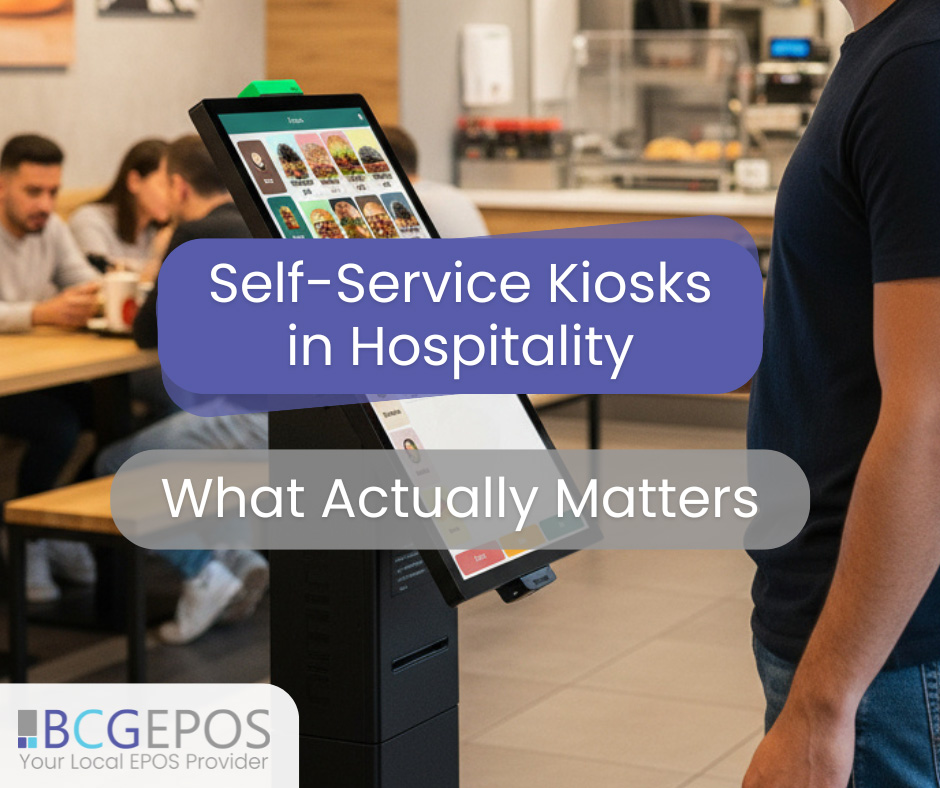
Self-service kiosks are now a familiar part of the hospitality landscape. From quick service restaurants to high footfall venues, they are often positioned as a way to reduce queues and improve efficiency.
However, focusing only on the surface-level benefits misses the bigger picture. Kiosks on their own do not transform an operation. The real value comes from how they are integrated, how they support service flow and how they contribute to wider business visibility.
For hospitality operators considering kiosks, the question is not simply whether to install them. It is how to make them work as part of a connected system.
Why Self-Service Kiosks Alone Are Not Enough
Many hospitality businesses are drawn to kiosks because of their perceived ability to reduce pressure on staff and speed up ordering. While this can be true, kiosks in isolation rarely deliver long term value.
A standalone kiosk system that is not integrated with your POS, kitchen or reporting tools can create new challenges. Orders may need to be manually managed, data can become fragmented and service flow may become inconsistent.
Self-service kiosks should not be viewed as a replacement for existing systems, but as an extension of them. Without integration, they risk becoming another disconnected touchpoint within the operation.
Modern hospitality technology needs to work as one ecosystem, not a collection of separate tools.
The Importance of Integration with Kitchen Display Systems and POS
The effectiveness of self-service kiosks depends heavily on how well they integrate with your hospitality POS system and kitchen display systems.
When a customer places an order at a kiosk, that order should flow directly into the main POS system and appear instantly on the kitchen display screens. This ensures that the kitchen has a clear and consistent view of all incoming orders, regardless of where they originate.
Without this level of integration, kitchens can become overwhelmed with multiple order streams that are not properly synchronised. This leads to delays, confusion and increased risk of errors.
A fully integrated setup allows kiosks, handheld devices and POS terminals to work together seamlessly. Orders are processed in real time, communication is clear and service remains consistent even during peak periods.
Capturing Data and Improving Reporting Across the Business
One of the most overlooked benefits of self-service kiosks is the data they generate.
Every transaction processed through a kiosk provides valuable insight into customer behaviour, ordering patterns and product performance. When this data is integrated into your central reporting system, it becomes a powerful tool for decision making.
Operators can analyse which items are most popular, how customers interact with menus and how ordering behaviour changes throughout the day. This information can be used to refine menus, adjust pricing and improve operational efficiency.
For multi site hospitality businesses, centralised reporting allows for comparison across locations, helping identify trends and opportunities for improvement.
Without proper integration, this data remains isolated and its value is significantly reduced.
Where Self-Service Kiosks Work Best in Hospitality
Self-service kiosks are not suitable for every type of hospitality business. Their effectiveness depends on the service model and customer expectations.
Kiosks work particularly well in environments where speed and volume are priorities. Quick service restaurants, takeaway outlets and venues with high customer throughput benefit the most.
They are also effective in settings where menus are structured and easy to navigate. Customers can browse, customise and place orders at their own pace, which can improve accuracy and reduce pressure on staff.
In contrast, venues that rely heavily on personalised table service may find that kiosks play a more limited role. In these cases, kiosks may be better suited to specific areas of the operation rather than being the primary ordering method.
Understanding where kiosks add value is key to implementing them effectively.
Self-Service Kiosks as Part of a Connected EPOS Ecosystem
At BCG EPOS, what we see in practice is that successful kiosk implementation always comes down to integration.
ACE Kiosk is designed to operate as part of a wider EPOS ecosystem, connecting directly with POS terminals, handheld devices and kitchen display systems. Orders placed through kiosks flow instantly into the system, ensuring consistency across all ordering channels.
This connected approach ensures that reporting remains centralised, service flow is maintained and staff can operate with confidence.
Rather than being a standalone solution, kiosks become one part of a fully integrated hospitality technology platform.
Making Kiosks Work for Your Business
Self-service kiosks can deliver clear operational benefits when implemented correctly. They can reduce queues, improve order accuracy and provide valuable data insights.
However, the real impact comes from how they fit into your wider system. Integration with POS, kitchen display systems and reporting tools is what turns kiosks from a simple ordering device into a meaningful part of your operation.
If you are considering introducing self-service kiosks into your hospitality business, it is worth focusing on the bigger picture. How will they connect, how will they support service and how will they improve visibility across your operation?
To learn more about how integrated kiosk solutions can support your business, visit: https://bcgepos.com/ace-kiosk/
Or speak to the BCG EPOS team on 01803 313 222.